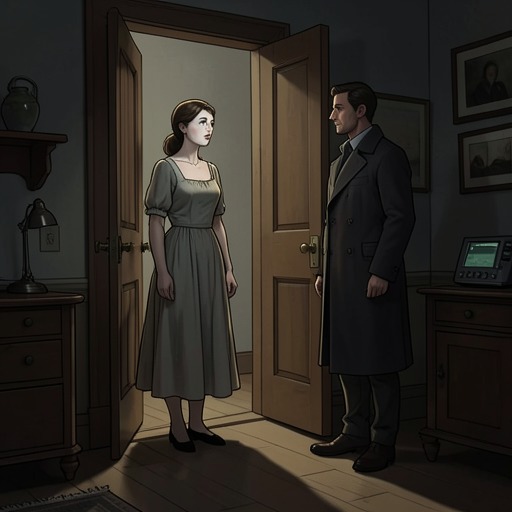
Charlotte Blacklock attempts to kill Mitzi
A Murder Is AnnouncedCharlotte Blacklock’s attempt to kill Mitzi is the immediate consequence of Mitzi becoming a credible witness to what really happened during the staged hold-up. Jane Marple anticipates that Charlotte will try to silence her, and the resulting confrontation exposes how fear and accumulating suspicion have narrowed Charlotte’s choices to crude violence.
Cause and Stakes
Mitzi had seen Charlotte in the hall with a revolver behind Rudi Scherz. Her view through the dining-room keyhole revealed that the hold-up was not what Charlotte had represented it to be: Mitzi had seen what actually took place. The danger for Charlotte was not merely that Mitzi possessed this knowledge, but that she might tell others and be believed.
Marple recognizes a weakness in Charlotte’s position. Because the key was in the keyhole, Mitzi could not actually have seen through it; Charlotte might therefore realize that Mitzi’s account was impossible. But Marple judges that the shock Mitzi has just experienced will occupy Charlotte’s attention. Charlotte is likely to concentrate on the fact that Mitzi claims to have seen her, rather than stop to test the physical possibility of the story. Marple’s plan depends on that moment of confusion.
The police deliberately add to Charlotte’s sense of security. Craddock pretends to receive Mitzi’s account sceptically and shifts suspicion onto Edmund Swettenham, who plays along by denying the accusation. This performance makes it appear, from Charlotte’s perspective, that Mitzi alone knows the truth and that the police have not taken her seriously. But if Mitzi persists, they might listen to her. Charlotte thus sees a narrow window in which she can prevent the testimony from becoming dangerous.
Marple’s Trap
Marple expects one of two responses: Charlotte might offer Mitzi money to keep quiet, or she might try to kill her. Either possibility would provide evidence of Charlotte’s intent; Sergeant Fletcher is positioned to witness an attempted bribe, while Marple herself is nearby. Marple explains that having two people in place is safer than leaving the matter to Fletcher alone.
Mitzi follows Marple’s instructions and leaves the room for the kitchen. Charlotte comes after her almost immediately. The kitchen is not, as Charlotte supposes, private: Fletcher waits behind the scullery door, and Marple is concealed in the broom cupboard. Marple notes that her slight build makes this hiding place possible. The arrangement turns Charlotte’s expected opportunity to silence Mitzi into a controlled test of what she will do.
Escalation and Exposure
Charlotte is already under pressure from the events of the same day. Hinchcliffe and Murgatroyd have had a scene, and Hinchcliffe has driven to the station. When she returns, Murgatroyd may explain that Letitia Blacklock was not in the room on the night of the shooting. Charlotte therefore has only a short time to stop Murgatroyd from speaking. Marple describes Charlotte’s response as an unplanned, crude murder, followed by a hurried return home and an effort to appear as though she had stayed by the fire.
The revelations about Julia’s identity add another threat. Charlotte breaks her pearls and fears that others may notice her scar. Then the Inspector telephones to say that he is bringing everyone to the house. With no time to recover or devise another elaborate deception, Charlotte faces Mitzi as a further danger. The attempt to silence her belongs to a chain of escalating acts: Charlotte is no longer protecting herself through the carefully managed appearance of the earlier deception, but reacting to the possibility that the people around her will connect the evidence.
The Voice in the Kitchen
Marple’s presence in the broom cupboard has a second purpose. She knows she can imitate Dora Bunner’s voice, and expects that hearing it may unsettle Charlotte. When Charlotte goes to the kitchen after Mitzi, Marple uses that ability as part of the trap. The voice recalls a person and a danger already bound up with Charlotte’s secrets; as Marple explains, it is what finally makes Charlotte go to pieces.
The scene resolves the immediate danger to Mitzi and exposes Charlotte’s desperate effort to prevent her account from being heard. Its method is characteristic of the investigation: Marple does not rely only on a direct accusation, but arranges the people, apparent suspicions, concealed witnesses, and familiar voice that make Charlotte reveal herself through her response. Mitzi’s survival and Charlotte’s breakdown mark the reversal: the witness Charlotte means to silence becomes the means by which her fear is brought into the open.